Climate ChangeandScience and Society
The rains are coming
Globalizing access to better weather prediction
Scientific success too often hinges on citations and high impact factors. But what happens when researchers working across disciplines aim for measurable impacts on real people’s lives? That is the central idea behind the University of Chicago-based Human-Centered Weather Forecasts (HCWF) Initiative, featuring UC Berkeley Atmospheric Science Professor William Boos. The HCWF works to provide weather forecasts laser-focused on agriculture. The HCWF was born about a year and a half ago, aiming to deliver innovation for agricultural resilience in the face of global warming. HCWF assembled a team of scientists, including monsoon expert Boos, as well as economists to turn the latest advances in artificial intelligence (AI)-based forecasting into actionable information for farmers. They have a dual goal: Increase local forecasting capabilities, and develop useful messages that can be disseminated at scale. Last summer, their efforts culminated in the Indian government sending 38 million farmers a first-of-its-kind AI-based forecast on the start of the monsoon rainy season. Behind this watershed moment was a long process of taking science into real-world policy.
Forecasts worth a year's work
“Weather forecasts are a fantastic way to improve livelihoods,” says Boos. He is not the only one to think so. At the 2023 UN Climate Change Conference (COP28) in Dubai, improved weather forecasts were recognized as an instant-impact investment for global agriculture. The COP28 host, the United Arab Emirates, partnered with the Gates Foundation to offer a large funding package for innovation in forecasts. The story of the Indian monsoon lays out why forecasts are considered such a promising policy intervention for agriculture.
“Weather forecasts are a fantastic way to improve livelihoods,” says Boos.
In basic terms, the monsoon is like a giant sea breeze. As land in the Indian subcontinent warms in late spring, air above the land warms and rises, drawing in cooler, moisture-laden air from the Arabian Sea to the west and the Bay of Bengal to the east. This moist air then rises, often forced by India’s high topography, producing prodigious amounts of rainfall. These rains bring relief from the scorching heat of April and May, as many Indians agree. But in the words of former President Pranab Mukherjee, the monsoon is also “India’s real finance minister.” Agriculture employs half of the population, and the monsoon governs the growing season. Kharif (or autumn) crops—staples like rice and maize and cash crops like sugarcane—cannot germinate and grow unless fields flood. “The decision of when to plant is consequential,” says Boos. “Plant at the wrong time, and you’ve lost a large fraction of your savings.”
But predicting the monsoon is a hard, 150-year-old problem. Monsoon onset varies regionally and exhibits notorious year-to-year variability. And it also has false starts—an initial spell of heavy rainfall can be followed by a dry spell before the rains begin in earnest. The Indian Meteorology Department (IMD) has tried for years to provide forecasts based on average historical trends. It cannot afford to run expensive models that capture the underlying physics, let alone provide localized forecasts with an assigned degree of confidence. The cost of running such models lies at the heart of why AI can be such a game changer in the weather forecasting space.
“The decision of when to plant is consequential. Plant at the wrong time and you’ve lost a large fraction of your savings,” says Boos.
An AI breakthrough
Weather forecasting is hard. Weather is governed by very complex interactions of many interconnected physical systems, like the ocean, the clouds, and the Earth’s surface. Since the 1960s, atmospheric scientists have been hard at work turning an increasing portion of the underlying physics into mathematical representations of the atmosphere. Scientists call these collections of equations physics-based forecasting models. By solving the equations, these models can simulate the future of the atmosphere. These models are impressive feats of science. Today, a forecast seven days out is as good as a three-day forecast in the 1980s: truly meteoric progress.
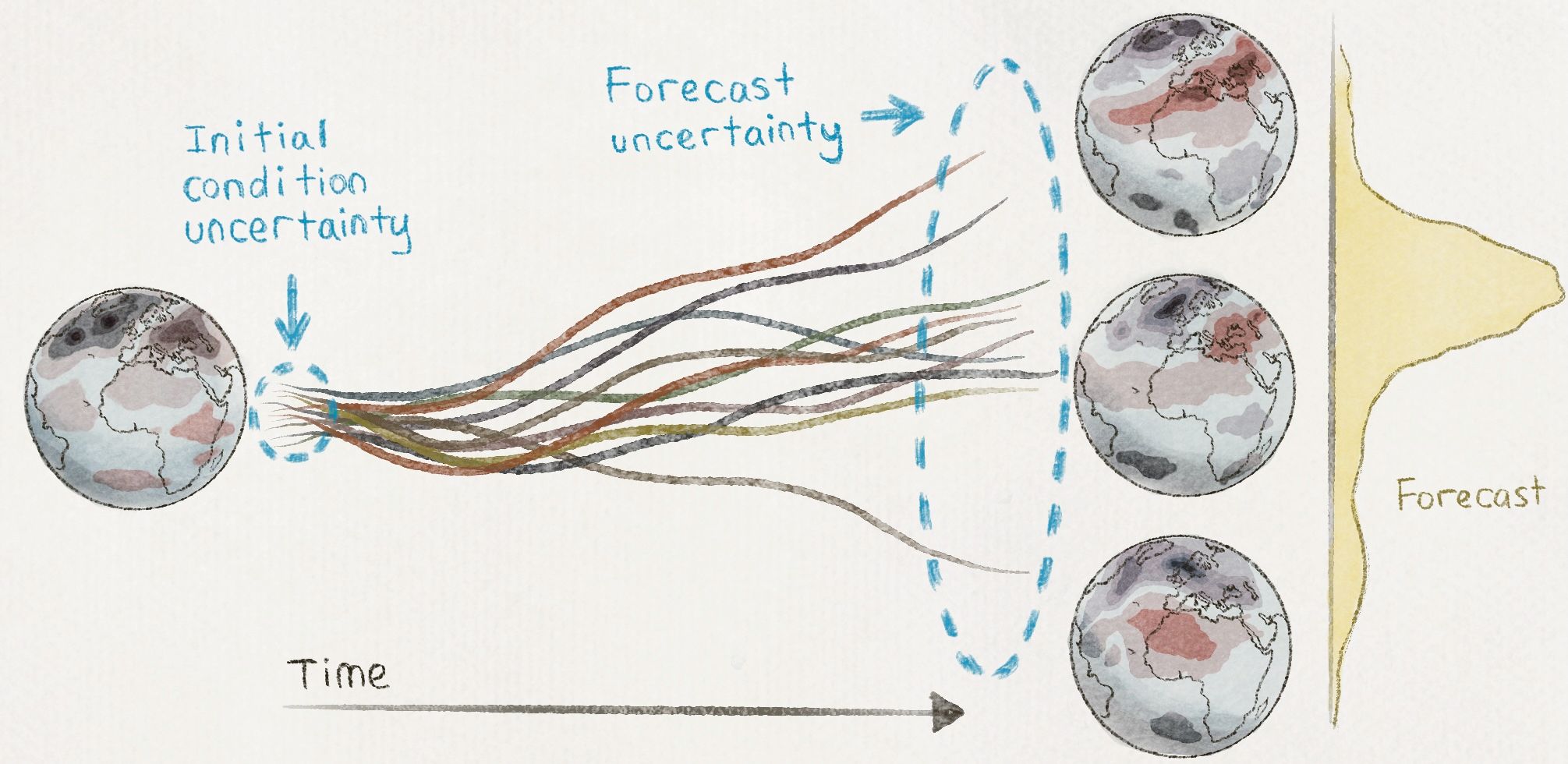
But there’s a catch: the physical systems governing the atmosphere are chaotic. Change the starting conditions a tiny bit, and you get a wholly different answer—the butterfly effect in action. Because our knowledge of the state of the atmosphere at any given moment is imperfect, running even the best model with a single best guess on inputs can mean a forecast that is way off. As such, all modern forecasting depends on running ensembles—using slightly varied starting points to provide a range of outcomes. This is what makes forecasts probabilistic: they come with a degree of confidence. But this comes at a massive cost. A single run of today’s most advanced model takes immense computational power. Running ensembles is a gargantuan task, possible only for the wealthiest nations with the most powerful supercomputers. And yet, it is still only feasible for ensembles to contain tens of alternative simulations.
“No one had yet demonstrated whether these predictions could be used for a locally specific, societally consequential problem,” says Boos.
This all changed in 2022. A team led by computer giant Nvidia that included UChicago AI expert and HCWF co-lead Pedram Hassanzadeh shocked the weather forecasting world by presenting an AI model that was as good at predicting global atmospheric variables as computationally expensive physics-based models. Since then, many others have followed. Instead of solving complex equations via the use of numerical approximations, AI weather prediction models learn patterns from observed atmospheric variables. It takes a long time and significant computation for models to train and learn these patterns. But once they acquire the knowledge, most can be run on a laptop, and, crucially, their developers have made them openly available. This makes running ensemble forecasting with thousands of alternative realizations possible, even for organizations like the IMD.
To Boos and his UChicago colleagues, AI’s “surprising” skill was a golden opportunity for the monsoon onset problem. AI models were trained by minimizing their average error over the whole planet—they were made to excel at global weather forecasting. “No one had yet demonstrated whether these predictions could be used for a locally specific, societally consequential problem,” says Boos. With the impetus provided by the COP28 funding package, HCWF assembled a team of scientists to evaluate AI models for the localized task of monsoon onset prediction. In a careful benchmarking exercise, they evaluated all available open-source AI models and ended up choosing Google’s NeuralGCM and the European Centre for Medium-Range Weather Forecasts’ AIFS models. These were cheapest to run and could make precise forecasts without missing onsets or giving too many false alarms. The team also found no model was perfect: each tended to be overconfident in their onset certainty. They therefore developed a blended strategy using historical trends to correct overconfidence. A technical solution was finally in place.
Monsoon forecasts for Indians, by Indians
Armed with a promising state-of-the-art solution, the HCWF came before the step where most researchers fail: taking the science to the real world. For researchers from high-income countries seeking to operate in a low-income country, perhaps the easiest thing to do is to parachute in: make all decisions and implement things as they see fit. But this is far from effective. In its 2025 progress report, the United Nations Office for Disaster Risk Reduction states that any forecasting or warning effort delivers best when locally led and user-oriented. Finding the best way to do this often proves a hurdle. Boos says the presence of the economists was the “secret sauce” in this regard. “They had gotten the optimal forecast via a back-and-forth with the farmers. They had been out there asking, ‘If you have a prediction, how do you best format it? What is the best type of information to get out?’”
A UChicago team led by economist Amir Jina had asked the question: Are forecasts better than just having insurance against such failures? They ran trials in a few villages in central India. Some farmers were offered an early version of a localized, bespoke probabilistic forecast, while others were offered insurance. Farmers offered the forecast changed their behavior and abandoned prior beliefs about the season. Those who thought the monsoon season would be longer than forecasted scaled back investment, while those who were pessimistic about the season increased their investments, resulting in an average 22 percent increase in productivity.
By early 2025, HCWF took the case to the Indian Ministry of Agriculture and Farmers Welfare, and together they formed a plan. HCWF worked with a non-profit, Precision Development, to develop messaging in 13 local languages. The Ministry would employ m-Kisan, a message delivery system running since 2013 that can tap into vast registries of farmer contacts. m-Kisan ultimately delivered week-by-week probabilistic forecasts on monsoon onset to 38 million farmers. The 2025 monsoon had a dry spell followed by an initial rainy period—the ultimate litmus test for a forecasting framework. But the AI framework developed by the HCWF scientific team caught it, and farmers received a correct forecast four weeks in advance.
Farmers welcomed the forecast with open arms. In a post-message survey, farmer Parasnath Tiwari, from the central state of Madhya Pradesh, said that he found the information “useful, and shared it with others.” Fellow farmer Arvindkumar Haridas added, “Everyone was farming according to the forecast. The monsoon arrived right on time, and everyone was prosperous.” It is not hard to see why this was a success. The ministry made the final go call and used its own infrastructure to deliver millions of messages. The messages did not come from some faceless black box in a foreign country, but from an agency farmers can judge with their vote. Moving forward, Indian scientists are being trained by the HCWF to run and evaluate the models for themselves, paving the way to full Indian ownership of the process.
“The effort to democratize access to ensemble weather prediction is really in its infancy, perhaps not even born yet,” Boos says excitedly.
After last summer’s success, Boos and the HCWF crew have big plans. Improving their monsoon AI framework’s precision and rolling it out to all Indian farmers are immediate next steps. But HCWF scientists know that there is a lot of untapped potential in AI-based forecasting. “The effort to democratize access to ensemble weather prediction is really in its infancy, perhaps not even born yet,” Boos says excitedly, adding “this is what really drew” him to this work. The HCWF and partners from the UK plan to expand efforts to Africa, working with locals to build similar rainy season forecasting capabilities there. As for their next scientific endeavor: predicting extreme weather events, like the individual storm and flood events that form part of a monsoon season. Could the AI models be as good as traditional models once again? Boos remains confident. In the end, science is all about making a real difference. The HCWF looks to have found a great way to do just that.
This article is part of the Spring 2026 issue.