A taste of Ohlone culture
The 'ammatka Cafe brings Ohlone cuisine to the Berkeley community
From the Lawrence Hall of Science to the San Francisco Bay, the land now occupied by UC Berkeley and the municipalities of the East Bay was once inhabited by thriving communities of Chochenyo-speaking Ohlone people along the Strawberry Creek watershed, fishing for salmon, eating berries, and trapping game.
UC Berkeley has an especially fraught history with the Indigenous people that originally inhabited the land our campus sits on. Since its founding, UC Berkeley has continued to harm the people whose lives and lands were taken to found and run the university. In 1925, anthropology professor Alfred Kroeber erroneously declared that “the Ohlone people [were] extinct for all practical purposes.” Into the early 21st century, the university refused to comply with the Native American Grave Protection and Repatriation Act (NAGPRA), obscuring and overlooking the role the university played in the continued erasure of Ohlone people and culture. To reckon with this troubling past, UC Berkeley began working with Vincent Medina and Louis Trevino, professional chefs and members of the East Bay Ohlone community, to establish the ‘ottoy Initiative in 2023. Referring to the intention of mending and repair in the Chochenyo language, this initiative hopes to “establish a just and respectful relationship with the local Indigenous community,” while also supporting Indigenous students on campus. The initiative has created a wide range of educational opportunities for all ages, from museum exhibits to culinary experiences. In February 2026, the initiative’s newest project opened to the public. The ‘ammatka Cafe offers guests at the Lawrence Hall of Science the opportunity to try Ohlone cuisine and learn more about the past, present, and future of East Bay Ohlone people.
The fraught past
Like many land grant universities across the United States, UC Berkeley was “given” a parcel of land to develop a university. What masqueraded as a donation from the US government—in exchange for agricultural research to secure a food supply for the developing nation—was really an astronomical wealth transfer from Indigenous communities to university endowments.
At its height, UC Berkeley held the remains of over 10,000 humans and over 50,000 sensitive objects. These remains were used in anthropological research and teaching, with little attention paid to where they came from. In one case, a box of Ohlone remains was simply labelled “lab” and passed down for research and education by many anthropology professors.
NAGPRA became federal law in 1990 and required public institutions to repatriate all remains and objects in their collections to the tribes and communities they belonged to. But UC Berkeley has been reluctant to return remains to their rightful owners, adhering to a conservative reading of the legislation and requiring an impossible level of proof for repatriation.
According to ProPublica, UC Berkeley still holds the fourth largest collection of Indigenous remains of any university nationwide, and up to 60 percent of the total remains the university has held are still in its collections.
Indigenous activists pressured the UC system to repatriate their collections to Indigenous communities throughout the state. But until recent years, the university did little to improve its relationship with East Bay Ohlone people. Finally, in 2017 the university changed course and made complete repatriation its primary goal, and in 2021 it established its land acknowledgment in collaboration with East Bay Ohlone people.
‘ottoy Initiative
In 2023, the university established the ‘ottoy Initiative with East Bay Ohlone people in hopes of beginning to mend the relationship between the university and the original and current inhabitants of the land. The word ‘ottoy represents a philosophy and intention of repair and mending in the Chochenyo language. Broadly, the initiative hopes to tell the honest story about the original and continuous inhabitants of this land. Pushing back against centuries of repeated and accumulating harmful practices that sought to erase Indigenous history, this initiative shows the public that Ohlone people and culture endure. Cofounder Vincent Medina tells me, “The initiative came to be from a desire to see Ohlone culture represented in a full, specific, and legitimate manner that goes beyond solely the campus land acknowledgements that existed before the initiative took hold—to tell our story with our own voices and create space where Ohlone people see themselves.”
“[The ‘ottoy Initiative is] an extension of the love we have for [our] elders, for our forebears, for our dignified culture, and for the East Bay, where we have always been.”
-Vincent Medina, cofounder of the ‘ottoy Initiative.
Medina and Trevino have been cultivating and highlighting Ohlone culture for years. Before the ‘ottoy Initiative, they opened Cafe Ohlone in downtown Berkeley, the first Ohlone restaurant in the world. The pair have spent years learning the Ohlone culinary traditions from their elders and wanted to adhere to traditional methods of serving food. As part of establishing the ‘ottoy Initiative, in 2023 the Cafe relocated to the ‘ottoytak—The Place of Repair—outside the Hearst Museum of Anthropology, a symbolically important location given the collections held there and the historic practices of anthropologists and archaeologists.
Medina notes that this work did not start with him and Trevino, but that, “A multi-generational effort is instilled in us by our honorable elders who have always continued our traditional culture.” He says the initiative is, “An extension of the love we have for those elders, for our forebears, for our dignified culture, and for the East Bay, where we have always been.”
Medina makes it clear that their partnership with The Lawrence has been rewarding. “When the initiative was inaugurated, we were greeted by a community of Lawrence colleagues that wanted us to be present and wanted our traditional scientific knowledge, Chochenyo language, culinary traditions, and aesthetics represented and seen throughout the space. This steadfast support has never wavered, and the positive, familial feelings we have for The Lawrence have only grown since ‘ottoy’s establishment.”
Trevino and Medina play an integral role at The Lawrence in centering the language, experience, and knowledge of Ohlone people throughout the museum. They helped to lead multiple groups of intergenerational Ohlone people in developing mixed and virtual reality experiences for museumgoers. These experiences seek to connect guests with the landscape in ways that leverage Ohlone ways of knowing.
The Elizabeth Karplus Outdoor Nature Lab, designed by Trevino and Medina, features an ecosystem that is culturally important to East Bay Ohlone people. Signage features Chochenyo plant names, and visitors can tap their smartphones on signposts to learn more about the plants and their relevance in Ohlone culture. One plant highlighted here is hawwen, or Emerald carpet manzanita (Arctostaphylos sp), a shrubby, drought tolerant plant with large pink and white flowers. East Bay Ohlone people would smoke and dry fish while burning the woody red stems. They also make tea using the fragrant stem tips mixed with manzanita berries. Manzanita flowers also attract native pollinators such as hummingbirds and bees.
The initiative also collaborates with researchers on campus. Medina and Trevino work with ecology professor Mike Boots and his lab to investigate interactions between native plants and pollinators. Other collaborations include invasive plant management with the Cal Forestry Club and introducing medicinal and culinary gardens at the Russell Research Station near Briones Regional Park. The founders see The Lawrence as a great launching point for a myriad of collaborations, saying, “The Lawrence is a space where we can promote this important work and see it spread downhill to the rest of the university.”
‘ammatka Cafe
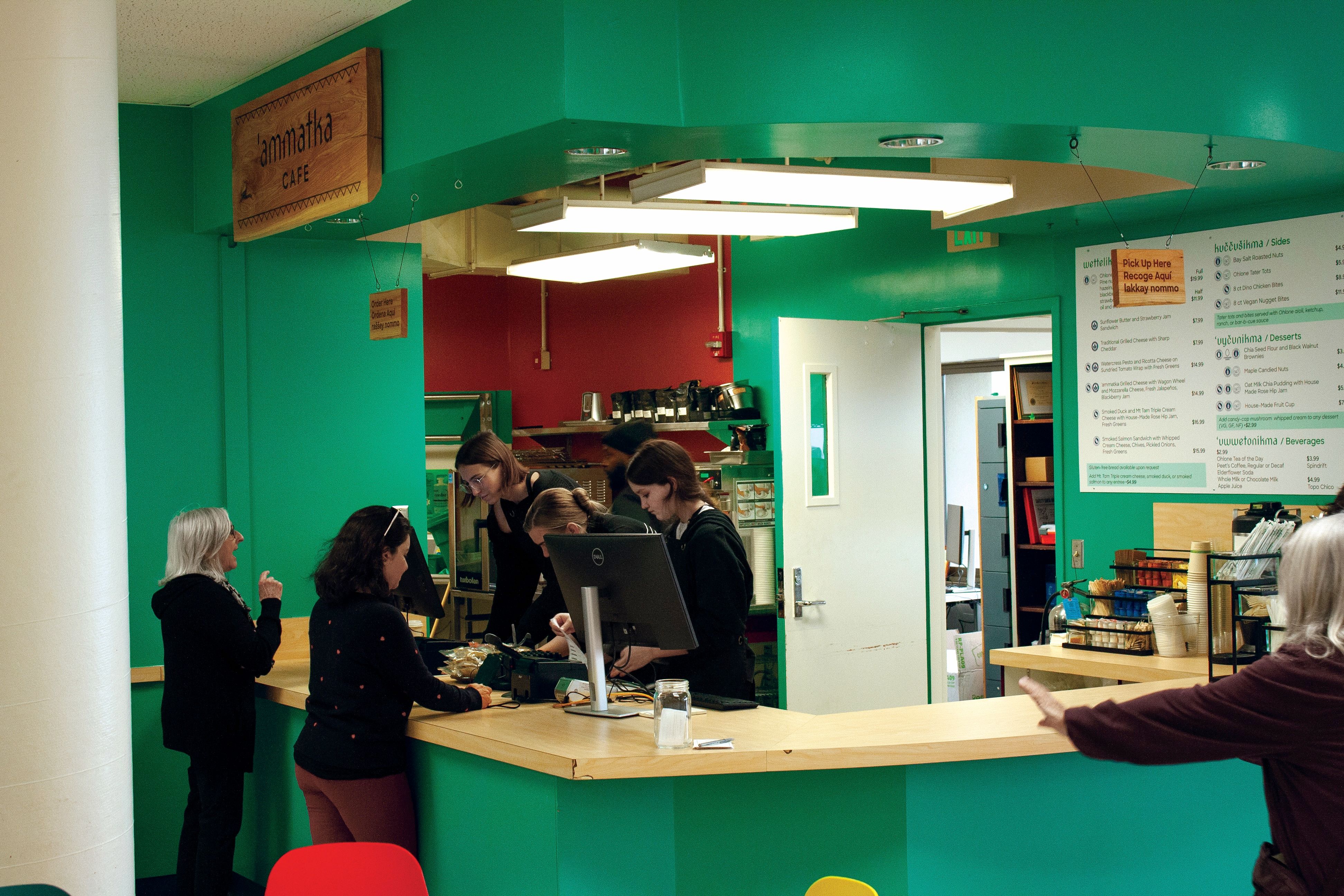
Since February 2026, visitors to The Lawrence Hall of Science have had the opportunity to try Ohlone cuisine at the newest development of the ‘ottoy Initiative. The ‘ammatka Cafe serves family-friendly food inspired by traditional flavors and serves as the latest approach in intertwining Ohlone knowledge at The Lawrence. These flavors seek to blend the knowledge and wisdom of the founders’ Elders with modern twists, making it approachable for all ages.
Trevino and Medina have carefully crafted their menu, leveraging traditional Ohlone flavors as well as their visionary cooking experience. “When Louis and I look to the ‘ammatka menu we feel proud of what we’ve been a part of creating. It’s a menu that is avant-garde, traditional, yet also of this time, and still points to Ohlone futurisms,” Medina tells me. A recent meal consisted of a smoked duck sandwich, a watercress pesto wrap, Ohlone tater tots, and an elderflower soda. Medina emphasizes how unique and empowering it is to run this kind of operation at a well-known science museum. “I mean, what other science center anywhere hosts an Indigenous eatery that picks fresh black sage for tea and has candy cap mushroom whipped cream or housemade rosehip jam? There really is nothing like it.”
Medina credits the work of Dierdre Green, the ‘ottoy Initiative executive director, and Rena Dorph, the director of The Lawrence Hall of Science, as being particularly instrumental to the success of the café as well as the broader initiative.
The café has had a successful start. Medina explains that in just a couple weeks, “Already we’ve witnessed immense excitement and support from our East Bay Ohlone community, our Lawrence colleagues, and the general public.”
The novelty and impact of this work is not lost on the initiatives’ founders. “There has never been something like the ‘ottoy Initiative or ‘ammatka Cafe; we regularly see how much positive change has happened since ‘ottoy’s establishment, and we look forward to seeing this powerful initiative grow, spread, and continue to affect consciousness and build understanding,” Medina says.
The continued growth of the partnership between UC Berkeley, The Lawrence, and East Bay Ohlone people requires trust and understanding, which can be nourished through culinary traditions and shared food. Medina tells me, “For our guests that dine with us in this curated space that affords an expansive view of ‘ommu (San Francisco Bay), the East Bay flatlands, and the Golden Gate to the Pacific Ocean, diners learn about our living Ohlone culture through our cherished cuisine and directly view the beautiful land that we’ve always loved in a fuller way. And for us East Bay Ohlones, we feel greater representation, understanding and increased respect for our culture as some of our favorite dishes are served the way we eat them at home. In this way, ‘ammatka Cafe works to the benefit of a multitude.”
To learn more and to support Mak-'amham / Cafe Ohlone visit https://www.makamham.com
This article is part of the Spring 2026 issue.