An unexpected path through the stars
Sticky, fluffy, icy chemistry
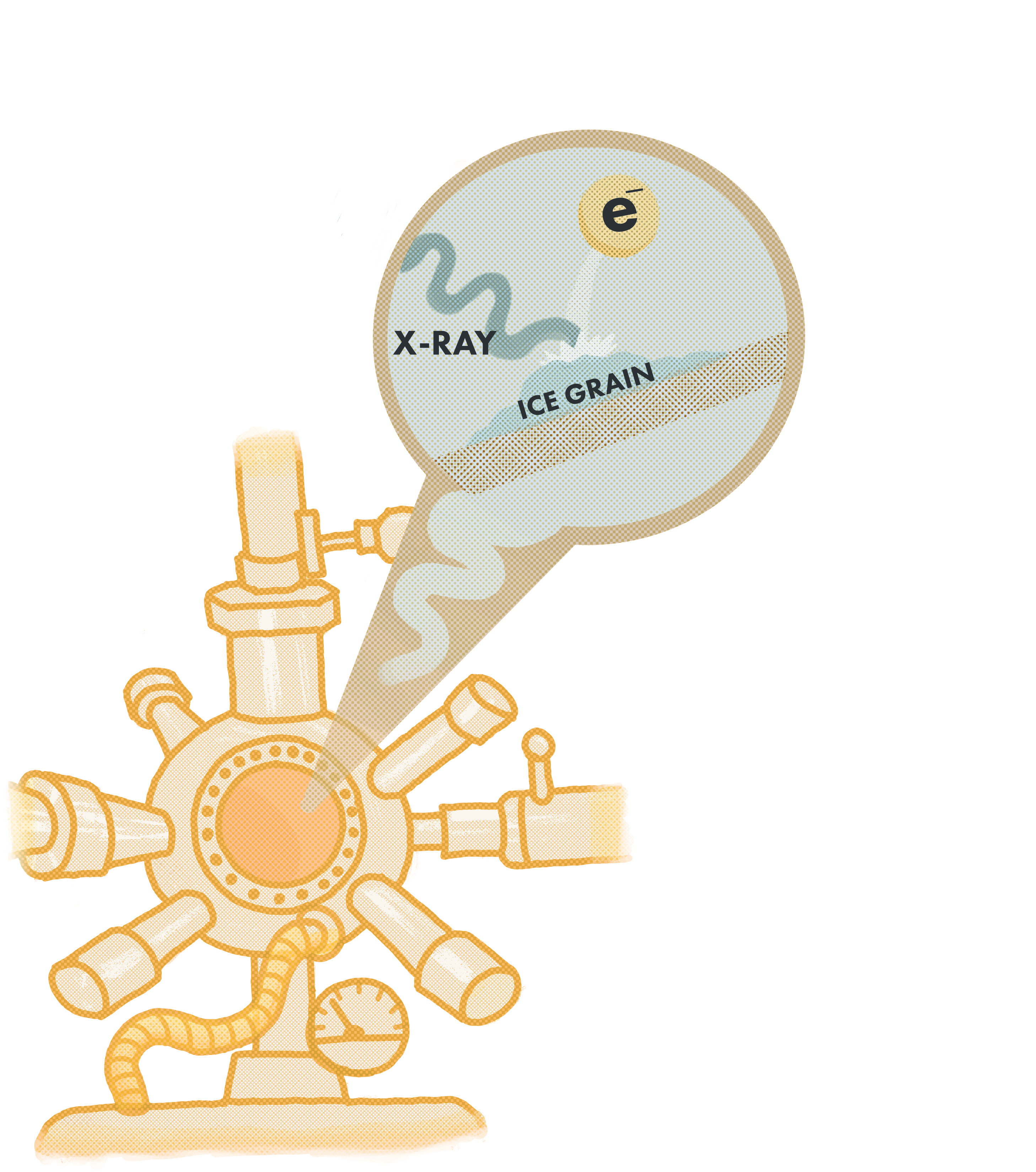
The equipment Eleanor Greenspoon uses to study stars and planets looks more like a miniature submarine than a telescope. Metal tubes wrapped in aluminum foil snake across the lab, converging on a foot-wide stainless steel spherical chamber with small glass windows. Black knobs connect to tubes and gas tanks. The chamber hosts its own propeller: a high-pitched pump that spins to push air out, creating an ultra-high vacuum that mimics space. In this strange, highly controlled environment, Greenspoon makes porous ice and measures chemical reactions on their surface.
Greenspoon studies chemical reactions on ice because stars form within molecular clouds composed of cold gas, ice, and dust. Dense regions of these clouds become gravitationally unstable and collapse, forming rotating protostars surrounded by proto-planetary disks. As density and temperature rise in the core, hydrogen fusion ignites, forming a main-sequence star. The surrounding disk of gas, dust, and ice sets the chemical composition of future planets. This initial chemical inventory influences planetary atmospheres, water content, and the potential to support life.
The icy, dusty particles present during star and planet formation differ from what we know here on Earth. In space, dust can be solid and hard, coming from metals, silicates, and carbon-containing species. The dust doesn’t have to be gray nor powdery. The “ice” can be made from water but also carbon monoxide, carbon dioxide, methane, and other volatile molecules. Even nitrogen, which is known as a gas on Earth, freezes into a fluffy solid in space. So, Greenspoon and her advisor Professor Jennifer Bergner built their unique instrument to understand the strange environments of space.
Astronomers study star and planetary formation using telescopes like the James Webb Space Telescope (JWST). JWST can identify the composition of molecular clouds by detecting unique patterns in the clouds’ light absorbance and emittance. But there’s a crucial gap: telescopes cannot reveal how microscopic chemistry affects the initial conditions for star and planetary formation. They cannot resolve the fine structure of interstellar ices, detect trace components, or capture the surface processes that drive chemical change. Yet local interactions and spatial arrangements ultimately shape the chemical pathways that influence planetary atmospheres, compositions, and the evolution of prebiotic molecules into life forms.
Scientists like Eleanor Greenspoon and Professor Jennifer Bergner probe what telescopes cannot: how molecules behave after settling onto icy dust particles. Rather than cataloging which molecules exist in space, Greenspoon investigates what happens after landing: whether molecules react with neighbors, rearrange, or reshape the surrounding ice. She examines which chemical transformations are possible, favorable, and rapid depending on ice porosity and composition. Greenspoon’s homemade, submarine-like device makes it possible to measure these microscopic reactions. By mimicking the cold vacuum of space, her module enables gases to be mixed accurately and cooled into an icy layer atop a metal surface. To accurately measure low-pressure chemistry, Greenspoon must prevent contamination. The aluminum foil in her setup hides heating coils that vaporize sticky residues; these are then pumped out by the vacuum system to prevent tube contamination between experiments.
In addition to precise compositional control, Greenspoon’s setup allows direct measurements of surface chemistry. Greenspoon explains, “The surface is where gases can land and stick, so surface binding is the starting point for chemical reactions.” Gas phase reactions would be extremely slow in space without surfaces, because gas molecules in interstellar clouds only collide roughly once every two months.
Because the surface of a particle is often less than 1 percent of its total volume, Greenspoon needs to use specialized techniques to probe surface chemistry. Greenspoon probes ultra-cold ices using a technique called XANES-TEY. This technique involves firing X-rays at a sample and measuring the electrons that are kicked out from the surface. Electrons from deeper within the material lose energy before reaching the detector. As a result, the technique detects changes from a nanometer-scale depth: roughly a thousand times thinner than a human hair. The technique is also composition sensitive, because each element has a different arrangement of excitable electrons.
With this foil-wrapped machine in a Berkeley lab, Greenspoon, Bergner, and their colleagues are decoding the chemistry of stellar and planetary birth. We may never watch a star or a planet form in real time, but experiments like these can reveal the molecular choreography that makes it possible.
This article is part of the Spring 2026 issue.