Third millenium thinking
A book about disentangling the information around you by Saul Perlmutter, John Campbell, and Robert MacCoun
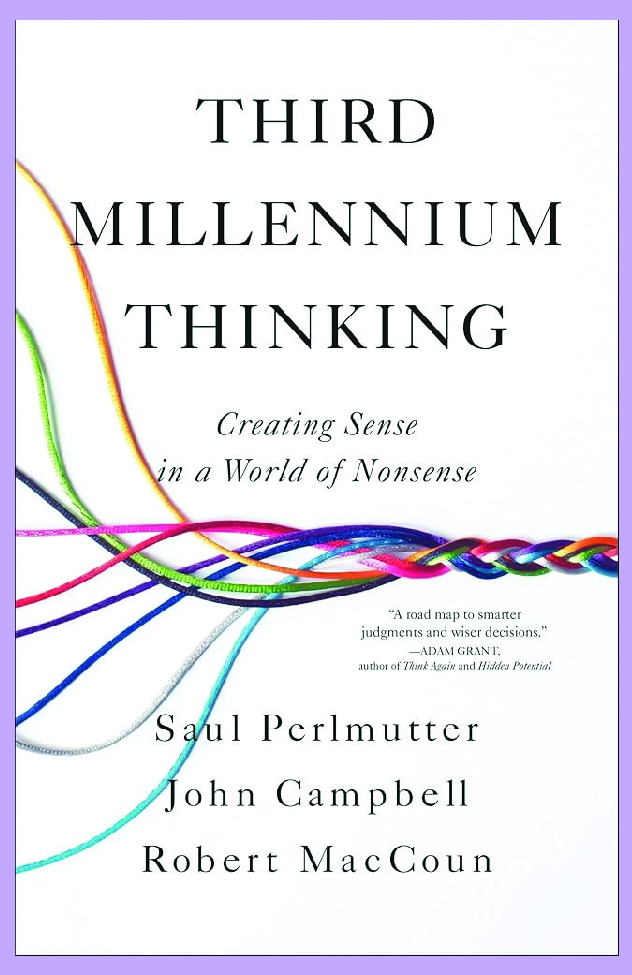
Whether pipetting in a lab or writing code at a computer, the experience of “doing science” can sometimes feel disconnected from everyday life. As a graduate student in the biological sciences, I have typically thought of scientific processes and skills as a separate “work” toolkit distinct from my more monotonous, day-to-day tasks and decisions. When I recently picked up Third Millenium Thinking: Creating Sense in a World of Nonsense by Dr. Saul Perlmutter (a physicist), Dr. Robert MacCoun (a psychologist), and Dr. John Campbell (a philosopher)—a book based on the Berkeley course LS22: Sense, Sensibility, and Science—I began to reconsider this default point of view. The book, which covers how to use scientific thinking to navigate the modern world, left me thinking more deeply about the role of scientific thinking in my own life and in our world as a whole.
In five main sections, the book focuses on different aspects of critical thinking: how we make decisions, how to navigate and understand uncertainty, how to identify our gaps in knowledge, how our different attitudes and approaches help us problem-solve, and how we can integrate the many facets of decision-making into our lives. Most of the book focuses on these processes on an individual level, while the last couple of chapters extend to a societal level.
Broadly, the book explores what critical thinking means through the lens of science with the goal of helping us choose what to believe, who to listen to, and how to make decisions while constantly weeding through overwhelming amounts of information. The book presents blueprints for thought at both the field-specific and general levels, woven together with thought-provoking examples and stories from each of the three authors. Beyond the emphasis on the scientific method, the combination of different academic backgrounds provides an interesting take on how these scientific approaches can be implemented. Anecdotes cover a range of topics, including Dr. Perlmutter’s time performing astrophysics research, Dr. MacCoun’s studies on drug policy, and Dr. Campbell’s thoughts on human perception. These varying points of view help make the book more generalizable and approachable to the reader.
On the level of individual solutions to improve critical thinking, this book is successful. Aspects of science that are explored, like probabilistic thinking, considering uncertainty, and having an optimistic but realistic attitude, are all components that I did not realize I utilize every day to make decisions and form opinions. This latter idea especially resonated with me, both while recouping following weeks of unsuccessful experiments and while trying out a new baking recipe at home. After reading the book, I have a greater appreciation for when these approaches pop up on a day-to-day basis, along with motivation to use them more frequently. I now find myself estimating my confidence in a statement after I say it, only to discover that I have a bad habit of relaying stories I find interesting without checking important details, something that I am now working on. Using scientific principles is a completely valid approach to decision-making that could be more concrete than many other approaches, especially in an overstimulating environment where many may crave a more tangible strategy. After all, the scientific method is a problem-solving technique, a basic premise that many people entrenched in doing science every day can take for granted over time.
On the level of population-spanning solutions, though, I’m left with too few satisfying resolutions. The sheer diversity of thought and even variance in information that individuals receive makes a one-size approach to decision-making impossible, and the book leaves the bigger question of how society can work together in decision-making largely unaddressed. The authors briefly touch on this challenge later, but I find this elephant-in-the-room topic the crux of implementing the book’s principles on a societal level. Issues around mistrust in science and scientists, which hinder scaling up the book’s ideas, require huge changes in how scientists communicate their work to the public and how society views the role of new technologies in our lives. While perhaps beyond the scope of this book, these ideas are central to the large-scale implementation of the authors’ framework and are worthy of more discussion.
On all levels, we need a reliable way to deal with decision-making—and fast. For better or worse, most of us have a wealth of information and, unfortunately, misinformation in our pockets. This crisis of information has become increasingly pertinent. The prominence of social media, surge of generative artificial intelligence, lingering distrust of science following the pandemic, and current volatile American political climate have all coalesced in a way that requires a tangible and measured solution. While such answers to our mounting issues have been few and far between, Third Millenium Thinking is a thought-provoking and optimistic start for thinking about how we might be able to get there.
This article is part of the Spring 2026 issue.