More than just a t-shirt
The race to understand berkelium
In 1940, while bombarding uranium-238 with deuterium nuclei (one proton and one neutron), Glenn T. Seaborg and his team at UC Berkeley created plutonium, taking the first step on a path that would ultimately lead to nuclear weapons. The team was not deterred by the danger of this element; in fact, they were motivated to venture deeper into the periodic table and discover heavier, more radioactive elements. Over the next 34 years, 10 new transuranic elements (those beyond uranium on the periodic table) were created. Among them was element 97, berkelium. Allegedly, the names of four of these new elements were decided prior to their discovery by the research team at Lawrence Berkeley National Laboratory (LBL). Just in case anyone questioned where the home of nuclear chemistry was, they left the address on the periodic table: lawrencium, berkelium, californium, and americium.
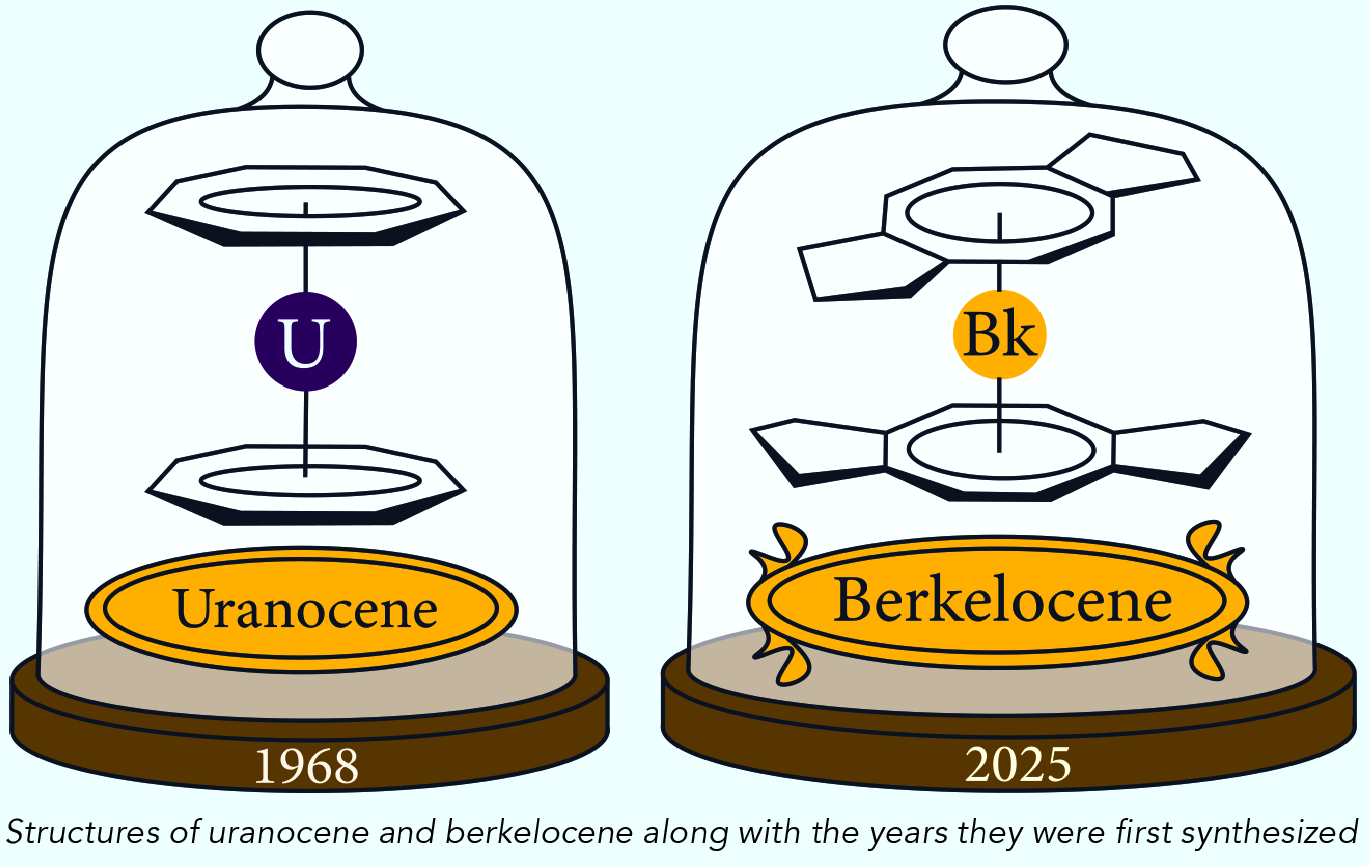
Almost 80 years later, UC Berkeley’s ambitions for its namesake element are no longer tied to generating nuclear weapons, but rather to improving our understanding of electronic structure and stability in one of the most hostile corners of the periodic table. Here, elements bond through expanded f-orbitals, a poorly understood set of seven orbitals that can contain up to 14 electrons. A team from UC Berkeley and LBL recently published a paper in Science investigating f-orbital bonding in a new organometallic complex called berkelocene, a species containing a berkelium atom sandwiched between two cyclooctatetraene (COT) ligands.
Understanding bonding at the edge of the periodic table is not done purely for academic interest, but for waste management on the planetary timescale. According to Professor Polly Arnold, director of the Chemical Sciences Division at LBL and a corresponding author on the paper, “Our nuclear waste legacy is full of these heavy element compounds and, if we understand them, we can separate out the nastiest radioactive species and pacify them.” This means that we would only need to curate our nuclear waste for thousands of years, not millions.
One of the first major steps toward understanding f-orbitals was the 1968 creation of uranocene, where uranium is sandwiched between two COT ligands (another UC Berkeley achievement!). Though this was itself a triumph, mysteries about f-orbital bonding remained. “These heavy elements are really difficult to predict computationally,” says Arnold, “so doing experiments on them is crucial.” Berkelocene differs slightly from its uranium analog in that each COT ligand is fused with two cyclopentane rings, forming an hdcCOT ligand. This design was deliberate: the staggered arrangement of the hdcCOT ligands enhances air stability and improves crystallinity. Numerous COT derivatives were synthesized and tested, but the hdcCOT variant proved uniquely capable of yielding crystals suitable for structural analysis.
To characterize the crystal structure of typical inorganic compounds, chemists use a technique called single-crystal X-ray diffraction (SC-XRD). First, a complex is synthesized, purified, and then allowed to crystallize slowly from solution, forming a regular solid in which molecules are arranged in repeating units. A suitable crystal is carefully removed from the mother liquor (yes, this is the technical term), coated in a protective oil, mounted on a loop, and placed into a diffractometer. X-rays are directed at the crystal, and the resulting diffraction pattern is recorded and analyzed while the crystal is rotated. From this data, chemists map the electron density to determine atomic positions and molecular geometry. SC-XRD is a powerful technique that reveals the precise structure of a compound in the solid state and has become expected for new organometallic complexes.
SC-XRD is a fragile process at the best of times: crystals may be too small to analyze or leave solution as an amorphous powder, or they may decompose or crack during growth. Due to the eight-figure price tag per gram of berkelium, each researcher had to first demonstrate that their proposed chemistry would succeed using less dangerous and less precious analogs such as cerium and terbium. Even after this, each researcher was allowed just 0.3 milligrams of berkelium to work with!
The radioactivity of berkelium presented another hurdle: some isotopes are roughly 700 million times more radioactive than uranium-235, the primary component of nuclear fuel. “It takes just one molecule in that crystal undergoing radioactive decay to release so much energy that the whole crystal gets cracked, gets blown apart,” explains Professor Arnold, so the entire workflow, from synthesis to SC-XRD, had to be completed within 48 hours. For the safety of the researchers working with berkelium, all work was conducted in a negative-pressure glovebox, severely limiting dexterity, under the close supervision of radiation protection specialists. To avoid puncturing the protective barrier, needles and glass pipettes were prohibited and solvent choice was limited, further complicating the chemistry.
Despite these nearly impossible hurdles, the researchers still succeeded, making a step towards more sustainable nuclear waste disposal and elucidating fundamental structural and electronic features of the poorly understood f-orbital elements. “F-orbitals are more chemically active, more involved in bonding than we used to think they were,” explains Arnold. Even though the researchers expected berkelium’s f-orbital behavior to be similar to their proof-of-concept experiments with cerium and terbium, “We showed that their chemical properties were significantly different!” Arnold remarks.
Ultimately, this work marks another chapter in a story that began in the 1940s at UC Berkeley. From the discovery of berkelium to its incorporation into berkelocene, it serves as a reminder that progress in chemistry is made by testing our boundaries, even when venturing into the most inhospitable corners of the periodic table. As researchers continue this high-stakes work, the legacies of berkelium and UC Berkeley become ever more tightly entwined.
This article is part of the Spring 2026 issue.