{
"componentChunkName": "component---src-templates-article-js",
"path": "/article/2026/05/31/a-quarter-century-of-bsr",
"result": {"data":{"strapiArticle":{"id":"Article_6a1b7b70a1914505ee622e8a","title":"A quarter-century of BSR","subtitle":"25 years of scrappy students and our science stories","published_at":"2026-05-31T19:32:44.843Z","content":"When I started art directing for\nthe *Berkeley Science Review*,\nour 25th anniversary loomed\njust over the horizon. But the years that\ncame before my time were shrouded\nin mystery. In moments sandwiched\nbetween stress and the humdrum of\njam-packed workdays, I dove down the\nrabbit hole of our history. With overtones\nof nostalgia and gratitude, I listened to 13\nalumni of *BSR* talk about the magazine,\nhow it’s evolved over time, the people they\nworked with, and how being part of *BSR*\nshaped their lives. I exchanged emails\nwith many more alumni, dug deep into\nour old issues, and fumbled through any\nfolder of files I could find in our scattered\ndigital archives.\n\nYes, *BSR* is 25 years old—with 50\nissues in the books. In those years, *BSR*\nhas passed through the hands of 29 editors in chief, 24 art directors, and 22\nmanaging editors, as well as countless\nother writers, editors, and staff of various roles. These roles have typically been\nfilled by busy graduate students with a\nlove for science storytelling in its various\nforms. Their dedication keeps the spirit\nof this publication alive and makes the\n*Berkeley Science Review* what it is.\n\nOn the surface, *BSR* is a source of science news. It’s certainly critical for science\nto be accessible and well-communicated.\nBehind the scenes, however, *BSR* is also\na catalyst for cross-campus connections;\na gateway into opportunities beyond\nacademia; a long-standing community\nof passionate, curious, and hard-working\nstudents; and at the end of the day, a\nlabor of love.\n\n---\n\n*The first two issues of BSR were printed in black and white with blue (cyan) accents. The paper had a newsprint-like texture, both in a physical sense and in the halftone texture in their images. Unlike the elaborately illustrated look of our recent issues, they had a much more minimalistic design.*\n\n---\n\n\n\n## Beginning from a blip\n\nOur first issue started much like any\nrecent one, with a call for contributions\nacross campus. Like every issue, it entailed\ncountless hours of writing, editing, and\neyes strained staring at Adobe InDesign.\nIssue 1 was published in black and white\nwith blue accents in spring 2001 by a\ncluster of scrappy PhD students. “*BSR*\nstarted with a blip on the internet…an\nemail to the student community gauging\ninterest in starting a new popular science\njournal about [UC] Berkeley,” wrote Eran\nKarmon, our co-founder and first editor\nin chief, in his letter from the editor.\n“We wanted a multidisciplinary look at\nBerkeley science, past and present, and\nthat’s what the *BSR* is.” Some details\nhave been lost to time, but the founding\naspirations of *BSR* still echo loudly from\npast to present.\n\nFunnily enough, the blip that started\nit all came from someone who did not\nend up working on *BSR*: Kim Miller, a\nstudent in chemical engineering who\nwas also active in student government.\nTemina Madon (our founding managing editor) says, “Kim felt she was too\nbusy to participate, but she encouraged\nus to push the idea forward.” Temina\ntells me she and Eran “sent out a message\ninviting all interested grad students to\nan initial meeting on campus one night.”\nShe says, “The whole enterprise was a\nway for students to explore ideas they\nwere intellectually intrigued by—science\npolicy, science history, commercialization,\njournalism, entrepreneurship.”\n\nI also spoke to Jessica Palmer Ryen\nand Colin McCormick, both of whom\nwere heavily involved in our first five\nissues. Jessica was one of the students\nwho went to that initial *BSR* meeting.\nShe started as an editor before becoming\ncontent editor then managing editor, and\nshe worked closely with Art Director Una\nRen on magazine design and illustration.\nColin wrote for our first two issues and edited for our second and third. He later\nstepped up as editor in chief after *BSR*’s\nfounding leader, Eran Karmon, tragically\npassed away on March 5, 2003.\n\nIt is impossible to disentangle the\nsuccess or the spirit of *BSR* from Eran’s\ndiscerning eye, focused vision, and synergistic leadership. Though he was only 27\nyears old when he passed, he was already a\nprofoundly successful scientist and writer.\nHis résumé included many prestigious\nawards like the Fulbright, Goldwater, and\nAAAS Mass Media Fellowship. In a statement on his passing by Eric Sorenson from\nthe Seattle Times, where Eran completed\nhis AAAS fellowship, Eran is described as\n“a study in brilliance, youthful restlessness,\nrelentless accomplishment, and global\ninterests.” Poring through statements\nmade by Eran’s peers, colleagues, friends,\nand mentors, I piece together an image\nof Eran as someone with a quick-witted\nsense of humor and vocal opinions about\nboth science and society who “played the\nbanjo, ice-climbed, [and] loved country\nmusic,” wrote Amelia Heagerty for *The\nDaily Californian*.\n\nHearing about early editorial board\nmeetings, it’s evident *BSR* would not be\nthe organization it is today without Eran.\n“I feel really lucky to have been there on\nthe ground,” says Jessica, reflecting on her\nexperience as a member of the founding\neditorial team. “We wanted to give people\na way to engage with science, but in a\nmanner that we weren’t being supported\nto do as part of a traditional graduate\nprogram.” The founders also “felt strongly\nabout interdisciplinarity and talking to\npeople outside of your graduate program.”\nThey wanted to “enable people to share their research with a wider audience that\nwouldn’t otherwise hear about it.” Jessica\ntells me, “Eran was the force behind the\nconception of the magazine and its initial\nefforts,” and that “he had a vision of what\nhe wanted the magazine to be.”\n\nJessica recalls that at some initial *BSR*\nmeetings, “We argued a lot because we all\nhad different conceptions of how to get\nthis done, so I remember Eran sighing a\nlot and trying to keep us on track with\nthe discussion because we would go off\non tangents. I mean, you’ve got creative\npeople from really different backgrounds\ncoming together to create something\nnew.” She tells me two incredibly valuable aspects of his leadership were that\nhe “could be very creative and also very\nfocused and goal oriented.” He could get\nthe group to “come back to reality and\nget something practical accomplished.”\nJessica says:\n\n*“Trying to get us all to focus, get something\ndone, and do it well was an amazing\nachievement that he deserves full credit\nfor. I think at one point, I had a hard\ncopy of one of the articles that I wrote,\nand he had written comments and edits\non it. But I just remember his handwriting. It was very linear, neat, condensed,\nwhich was so fitting with his personality.\nIt was deliberate and focused, cramming\na lot of information into a little tiny space.\nAnd I remember all of his comments all\nover it because he took it very seriously.\nI mean, everything. He wanted to make\nsure that every article, every interview,\nwas the best it could be. He was really\na perfectionist, and he made our work\nbetter. He was really gifted, and it was\ntragic that we lost him.”*\n\nEran’s passing could have easily\nmeant the end of *BSR*, but he leaves\nbehind a powerful legacy as we continue\nto publish issues semester after semester.\nJessica recalls that some of the founders\n“questioned going on with the magazine,\nbecause it took the wind out of our sails.”\nIn her recollection, “We all thought\nof him as so closely connected to the\nmagazine. But at the same time, it was\nsomething that was so important to him.\nWe felt we had to continue because it was\nsomething that I firmly believe he would\nhave wanted to keep going, and it would\nmake him very, very happy to know that\nit is still going today.”\n\nColin tells me that having to write\nthe letter from the editor for the first\nissue of *BSR* without Eran was incredibly challenging. “We couldn’t ignore it\nor pretend it hadn’t happened,” he says.\nColin and the rest of the *BSR* team dedicated their spring 2003 issue to Eran’s\nmemory. In the letter, Colin writes, “We\nall mourn [Eran’s] passing, and we will\nmiss his energy and dedication. But we\nare proud to be carrying on his vision of\nan incisive, well-written journal about\nBerkeley science.”\n\n“It’s special to know that something\nEran created lives on in the world, and\nthat there is a new generation of scientists and artists and others continuing\nto explore the world in this way,” says\nTemina.\n\nThe Karmon family also started the Eran Karmon Memorial Fund shortly\nafter his passing to fundraise for “causes\nthat are a tribute to his memory and celebrate his life,” as stated in an announcement released by his family. One of these\ncauses was *BSR* itself. In Issue 8, the\n*BSR* started issuing the Eran Karmon\nEditor’s Award annually to the editor in\nchief to support hardworking, underpaid\ngraduate students and to ensure that there\nwould be someone willing to take on the\ntremendous role. The Karmon family\nmembers managing this fund passed away\nin recent years and the fund has since\nended, but their support has truly left a\nlasting mark on the magazine.\n\nThough *BSR*’s beginnings were\nentangled with grief, its founding was also\na source of joy. It marked the establishment of a now 25-year-old organization\nwhere graduate students can find levity\nand a collective sense of wonder. “I think\nall of us felt like the alien in our department who wanted to learn about other\ndepartments,” says Colin. “We wanted\nto do good science and graduate and get\nour dissertations done, but we also felt\nlike there was a lot more we wanted to\ndo.” For the first few issues, he remembers\n“a general sense of excitement that we’d\nfound this connection across scientific\ndisciplines.”\n\nJessica also looks back fondly on the\ncommunity she found through *BSR*: “I\nthink that what I enjoyed the most was\nknowing that we were creating opportunities for people to write and edit and do\nthis stuff outside of their graduate studies—for people to talk to people in other\nprograms that they never would have\nmet.” Jessica lists Eran, Colin, Temina,\nand other founding members like Heidi\nLedford and Donna Sy, and tells me she\n“probably would have never met any of\nthese people if it hadn’t been for the *BSR*.”\n\n“We all got into it for the same reason,\nthe curiosity and the excitement, that\nlove of discovery,” says Colin. “Maybe\nwe were just having a whole lot of fun,\nand that was the motivator rather than\nsomething broader.”\n\n## Struggles in starting a science magazine from scratch\n\nAlong with connection and joy,\nthe founders also quickly learned how\nmuch work truly goes into creating a\nnew publication: from financial woes and\nquestions about content to composing\nartistic visions. “It was probably a bigger\nchallenge than we had anticipated,” Jessica tells me. “We got to see the magazine\ncome together from nothing, but there\nwere also a lot of practical considerations\nthat we did not anticipate.”\n\nSome of these early struggles\nincluded navigating funding sources\nand working with publishers and printers. They also had to decide how much\nscience-focused versus science-adjacent\nwork to publish and what the magazine\nshould look like. “There was a lot of reserving rooms, meeting in conference\nrooms on campus, sitting around, and\nhashing out, ‘How are we going to get\nthis done? What kinds of features are we\ngoing to have in the magazine?’” In these\nmeetings, Jessica remembers Eran asking\nquestions like:\n\n*“‘What different types of things should\nwe have besides just a traditional article\nabout a topic? What other things should\nwe put in the magazine and why? How\ncan we make it fun and interesting and\nmore like a real publication?’ He was\nalways full of ideas. That was one of the\ngreat things about working with him: he\nwas just constantly proposing things. And\nthen, of course, because we all had different takes on it, we would all argue about\nwhether or not they were good ideas.”*\n\nJessica also recalls discussing whether\nit was really necessary to have a print\nmagazine and how much of the effort\nshould be spent on design versus text.\nShe and Una, being very design-oriented,\nwanted to have more art integrated into\nthe magazine, and to “have a design that\nwould be artistic and elevated above a\nnewsletter.” Jessica says, “We wanted to\nhave something that was recognizable, a\nsignature appearance of the *BSR*.” Doing\nso involved figuring out how to print the\nmagazine in full color rather than black\nand white and how to work with artists\nor photographers to find or create new\nscientific illustrations.\n\nThe thought and care placed on the look of the magazine precedes its impact\non *BSR*’s reputation and members. “I\nremember just being blown away by the\nartistry that went into this. Jess and Una\nhad done these incredible sketches and\ndrawings,” Colin says. “I think I had\nnever, as a physicist, realized that was\npart of the science craft. This was an\nincredible opportunity to learn about\nand see that, having had no familiarity\nwith it before.”\n\nIn our early days and through our\nhistory, the work that goes into the magazine hasn’t always reflected what people\noriginally set out to do. But the magazine\nhas persisted from peoples’ willingness to\nstep up and do what it takes to get each\nissue published and printed. “Honestly,\nwe all kind of did anything that needed\nto be done,” says Jessica. “So I’m not sure\nthat the job titles really add much.” Piecing together the list of *BSR* executive team\nmembers through the years, I noticed\nthat for one semester—spring 2005—the\neditor in chief, Kaspar Mossman, also art\ndirected the same issue.\n\nKaspar is still based in Berkeley, so\nI met with him at Caffè Strada. When\n*BSR* launched, Kaspar thought, “Man,\nthat looks like something I’d really like to\ndo.” But it took a few issues before Kaspar\ndebuted his first article in spring 2004 on\na device for low-field MRI called SQUID.\nKaspar later wanted to join the editorial\nboard himself, but those slots had filled\nup. Instead, the magazine needed a new art director.\n\nWith no prior experience, Kaspar\ntook up the mantle. He learned Adobe\nInDesign from the preceding art director,\nTony Le, and recalls, “All of a sudden,\nI had the whole damn magazine to lay\nout.” The next semester, Josephine Lee\n(fall 2004 editor in chief), ended up\nstepping down, leaving Kaspar with the\nmonumental task of leading the editorial\nboard and laying out all 50 pages of Issue 8. Kaspar says, “The roles, you fall into\nthem, and are you willing to learn how to\ndo it? And if you’re good at it, then just go\ncrazy, right?” He tells me it was “a lesson\nin constraints” with considerations like\nword limits, layout, and printing stipulations, and he speaks fondly and highly of\nthe *BSR* staff he worked with at the time.\n\n“We probably bit off more than we\ncould chew,” Jessica says. “But that’s\ngood because we probably wouldn’t have\ndone it if we’d realized how much work\nit would be. So, I think that in the end,\nit was all for the best. It was daunting. It\nwas a lot of time, but it was a labor of love.\nEveryone worked very hard.”\n\n---\n\n*If you’ve seen our big chunky yellow BSR distribution boxes around\ncampus or elsewhere in the East Bay, they were quite an effort to\nacquire! We once had none, once had only one or two, and now\na good many exist thanks to Katie Deets. She and Nicole Repina\n(fall 2018 and spring 2019 art director) had to fill the boxes with\npavers’ gravel from Home Depot to keep them from tumbling\naway. Not every building has a good spot to plop down a stack\nof science magazines. This thought may never occur to you until\nyou look for that spot. But when each issue of BSR is printed, our\nwriters, designers, and editors carry heavy stacks up and down\nthe hill and try to get them wherever we can.*\n\n---\n\n## Racing through our first decade\n\nIssue by issue, *BSR* continued to pass\nthrough the hands of different members\nand made it through its first decade.\nRachel Bernstein—our editor in chief\nin 2009—was first introduced to *BSR*\nwhile applying for graduate school in 2004. Having completed her bachelor’s\nwith a double major in biochemistry and\nEnglish, she knew she wanted to continue\nto pursue writing and communication in\nparallel with her research.\n\n*BSR* would have only been three\nyears old in 2004, but Rachel tells me,\n“From our perspective today, it was young.\nBut even at the time, it was very well\nestablished. It was a presence on campus.”\nShe says, “Enough of a path had been\nblazed, and *BSR* had standards and a\nway of doing things.” She recalls being\nreally impressed that *BSR* existed, and the\nmagazine made UC Berkeley a top choice\nfor her in choosing a graduate program.\nRachel started writing for *BSR* in spring\n2006 as a first-year rotation student. This\nsemester marked our 10th issue, and *BSR*\ncelebrated this milestone with a spread\ncovering nine follow-up snippets on\nstories from each prior issue. These nine\nissues alone had already accumulated a\ntotal of “428 pages, 183,971 words, 53\nstaffers, [and] 96 authors” (*BSR* Issue 10, page 6).\n\nRachel became an editor in spring 2008. She tells me it was a “tremendous learning experience, working with\nauthors, making sure that the copy is as\nstrong as it can be.” At this point, “Many\nof the staffers had been with the *BSR* for\nquite a while. They were very seasoned,”\nsays Rachel. “I was totally intimidated\nand impressed by these students who\nwere a few years ahead of me who had\nbeen doing this for so long.” She lists a few names for me: Meredith Carpenter,\nKaspar Mossman, Jacqueline Chretien,\nWendy Hansen, Matthew Mattozzi. Soon\nafter joining the editorial team, many\nof these students graduated and passed\nthe baton, and Rachel served as both our\nmanaging editor and editor in chief over\nfour semesters and continued to support\nvarious operations even after stepping\ndown.\n\nRachel says she “felt total imposter\nsyndrome at the time.” She recalls think-\ning, “How am I in charge of this? How am\nI the one that people are looking up to and\nexpecting answers from?” Michelangelo\nD’Agostino (fall 2006 editor in chief)\nexpressed a similar sentiment in his letter\nfrom the editor: “When the wise elders\nof the *Berkeley Science Review* gathered\nunder the cover of night in their hooded\nblack robes to anoint me the next [editor\nin chief], my first instinct was to turn\ntail and run.”\n\nBefore Rachel’s time on the executive\nteam, Meredith Carpenter was our editor\nin chief in fall 2007 and spring 2008.\nMeredith joined *BSR* as an editor for Issue\n10 and wrote many articles during her\ntenure. Meredith tells me, “It was really\nnice to have other activities outside of\nyour PhD, because even when things are\nnot working in lab, you can feel that sense\nof satisfaction that comes with completing something.”\n\nLike *BSR*’s founders, Meredith\nappreciated “meeting people—other\ngraduate students, faculty, Nobel laureates—I never would have interacted with\nif it hadn’t been for *BSR*.” *BSR* presents\na way to make your time at UC Berkeley\n“much richer, because you can have those\nexperiences outside of just being in your\nlab and interacting with the people in\nyour department,” she says.\n\nRachel shares Meredith’s appreciation for the community *BSR* brought her,\ntelling me that actually, “The folks who I\nmore remember are the ones on the other\nside of my leadership transition, the folks\nwho I was able to mentor and pass things\non to.” She names Hania Köver and Greg\nAlushin, the two editors in chief immediately after her, as well as staff like Josh\nShiode and Chris Holdgraf. “The names\nand the folks definitely stick with me\neven when we’re not in touch,” she says.\nEchoing what I heard from Jessica, Rachel\ntells me:\n\n*“It is such a labor of love. None of us or\nyou have to do this, and it takes a lot of\ncommitment and self-motivation to keep\nthings moving and to keep the standard\nhigh. But everyone on the staff always\nhad that, and it was such a pleasure to\nbe working with folks who we could share\nthat with.”*\n\nRachel also tells me, “Realizing\nthat you’re at the stage where you can do\nthings and you can be in charge and that\nyou’re not just in a position of taking in\nwisdom or products from other people—that’s what *BSR* was for me.”\n\n*BSR* indeed offers a unique opportunity for creative leadership and problem-\nsolving that many students have not had\nbefore. Jesse Dill, our web editor from\n2007 to 2010, tells me, “It was a scrappy\nbunch of folks, doing our best to pick up\nthe digital tools we needed to make the\nmagazine happen.” His first project with\n*BSR* was hand-coding an update to the\nwebsite for uploading articles online using\nPERL scripts. Around this time, Marek\nJakubowski, our art director from fall\n2009 through spring 2011, also gave the\nmagazine a massive makeover as the sun\nset on the first decade of the 21st century.\n\nMarek tells me that he was first\nroped into designing a Labscope layout\nby Tim De Chant, the art director before him. Having ample prior experience\nwith Photoshop from a background in\nlandscape photography, Marek quickly\npicked up InDesign and developed an\nobsession for design process and theory.\n“I was studying typography and color science, data visualization and publishing\nsystems,” says Marek. “The more I got\ninto it, the more I questioned why things\nare the way they are.”\n\nThe devil is in the details when it\ncomes to design, whether it’s placing\nlogos, choosing fonts for page numbers, or\nstructuring photo and illustration credits.\n“The conclusion for a lot of my questions\nwas a lot of things existed just because\nthey existed.” After one semester as art\ndirector, he made the leap and redesigned\neverything. “That was a crazy time. I\nhad 40 different versions of the logo” for\nevery context where it might be used. “I\nrealized what makes design look professional is consistency and having a reason\nfor specific things. There’s always going to\nbe exceptions, but I wanted to standardize\nit,” says Marek. *BSR* debuted its new look\nin fall 2010 for Issue 19.\n\n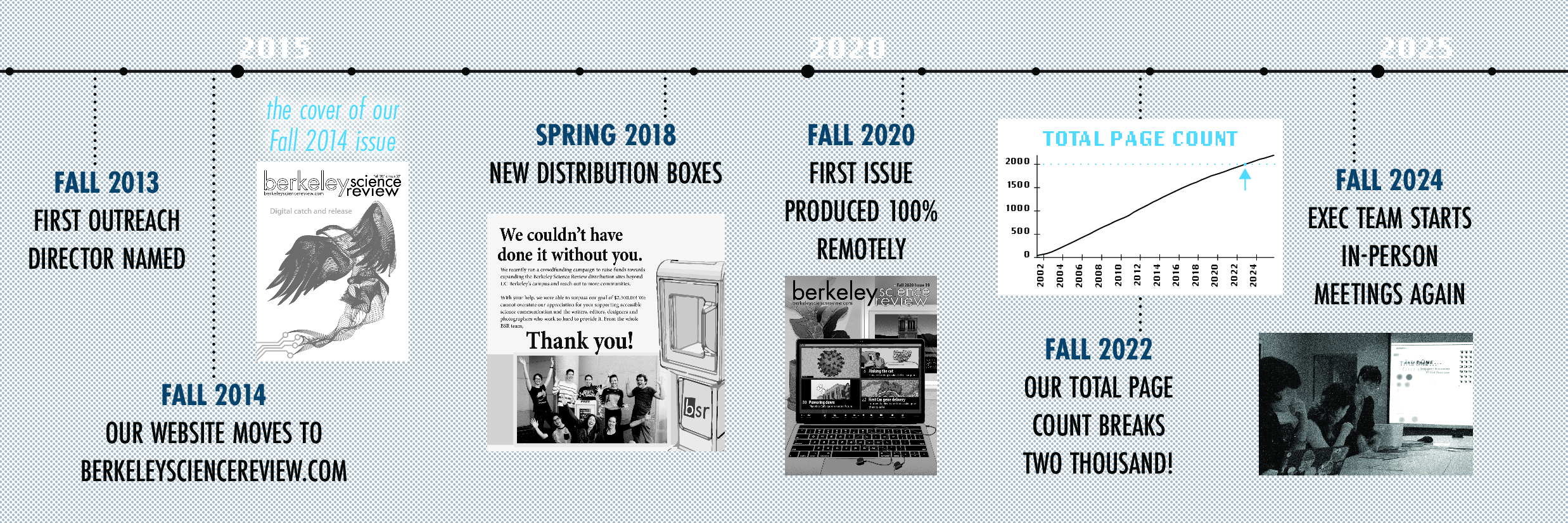\n\n## 20 issues in, 20 issues onward\n\nAs *BSR* hit its 10th anniversary and\n20th issue, its reach kept expanding\nbeyond the confines of the magazine\nitself. Through the 2010s, *BSR*’s scope\nexpanded so drastically that it may be\neasier to ask, “What didn’t *BSR* do?” We\nhosted creative outreach events and writing workshops, had a short-lived tablet\napp and a print-on-demand T-shirt store,\nand launched a brand-new web presence\nthrough our blog.\n\nThe idea of starting a tablet-compatible version of *BSR* was introduced\nin summer 2013 at a *BSR* retreat under\nthe discussion prompt, “How do you see\nthe BSR in five years?” This prompt also\nseemed to spark ideas like creating new\nleadership positions for development,\npublic relations, and outreach. At this\nretreat, the executive team also drafted\nup *BSR* organizational charts and job\ndescriptions to see how the organization\ncould be restructured to fit these new\npositions in. In fall 2013, Georgeann Sack (who also wrote, designed, and edited for\n*BSR*) became *BSR*’s very first outreach\ndirector.\n\nIn October 2013, Georgeann spearheaded the organization of an event\nfocused on the science of touch sensation\nfor the annual Bay Area Science Festival\n(BASF). It was co-organized with BAASICS (Bay Area Art and Science Interdisciplinary Collaborative Sessions), a San\nFrancisco based nonprofit organization,\nand KALX-FM Spectrum, a science\npodcast that aired from 2011 to 2014. It\nconsisted of 90 minutes of presentations\nby experts on touch sensation followed\nby a two-hour reception with interactive\nexhibits. Attendees could view mutant\nworms insensitive to touch and hang out\nwith touch-sensitive robots. There was\neven a live experiment involving communicating emotion through touch.\n\nFrom 2013 through 2019, *BSR* partook in a vast range of outreach events\nfrom the BASF and Cal Day to Discovery\nDays at Oracle Park (formerly AT&T\nPark) in San Francisco. *BSR* even helped\norganize a neuroscience room at the California Academy of Sciences’ Halloween-themed nightlife event in 2014.\n\nWithin the same year, Chris Holdgraf, a longtime editor and webmaster\nfor *BSR*, redesigned *BSR*’s website. In her\nletter from the editor for Issue 27, Alexis\nFedorchak wrote that “in the week after\nwe released Issue 26, more than 20,000\npeople visited our website” resulting in a crash that Chris had to remedy. He\nalso helped migrate the site from “sciencereview(dot)berkeley(dot)edu” to “[berkeleysciencereview.com](berkeleysciencereview.com),” where our website is now housed. This change was part of an effort\nto bring *BSR* to the broader Berkeley community rather than just the university. “I\nthink we wanted to have a place that felt\nlike it was our own,” Chris tells me. *BSR*\nwas “experimenting with different ways to\nconnect around scientific communication\nbeyond print media.”\n\nAn old Google Sheet from spring\n2019 shows that within the span of two\nmonths, *BSR* tabled at multiple recruitment events like GradFest and Cal Day,\nheld socials, hosted a writing workshop,\nand fundraised through Big Give. Amidst\nall the outreach, the publication never\nslowed. By the time we hit Issue 30 in\nspring 2016, *BSR*’s total word count broke\nhalf a million, as calculated by various\nformer *BSR* editors in chief. I shudder to\nimagine how many words we have written\nsince…\n\nSadly, these lively outreach events\ncame to a screeching halt in 2020 as the\npandemic struck. Our fall 2020 issue\nbecame “the first *BSR* issue produced\ncompletely remotely” according to Hayley\nMcCausland (2020 editor in chief) in her\nletter from the editor.\n\nPandemics are certainly a prime\nexample of massive global problems where\naccurate, clear, and well-disseminated\nscience communication saves lives, but this is true for many facets of the world.\nScience itself, from questions asked to\nfunding sources, is also deeply entangled\nin the workings of society. As the founders hoped, *BSR* has indeed attracted\nstudents with an appreciation for the\ninterdisciplinary nature of the world.\n\n---\n\n*Our alumni have branched off into a diverse range of careers\noutside of academia! Colin and Jessica were both AAAS Science\n& Technology Policy Fellows, and many other alumni were AAAS\nMass Media fellows. Jessica went on to get her JD from Harvard\nLaw School and now works in patent law. Wendy Hansen, spring\n2007 editor in chief, got an MD after working as a science writer\nand in communications for a science museum for a few years.\nRachel Bernstein is now deputy news editor for Science. I could\nwrite several thousand more words about all the ways other alumni\nare using their writing, design, editing, and other skills they’ve\ncollected from their time with BSR. And maybe I will in our blog…*\n\n---\n\n## 50 issues and beyond\n\nBut amid the innumerable contemporary problems plaguing the world,\nwhere does *BSR* sit? What are our hopes\nfor the future?\n\nI never personally experienced *BSR*\npre-pandemic or in the thick of it, but I\ndid get to work with Héctor Torres Vera,\nwho started writing for *BSR* in 2020.\nHéctor was also our managing editor for\nfour semesters from 2023 to 2025 and the\nreason why the executive team now meets\nin person again once a month. For the\nfirst few years of the 2020s, our writing\nand design timelines were a little bumpy\nas communication was more difficult to\nnavigate while we dealt with the chaos\nof those years.\n\nAs the world grappled with the grief\nof the pandemic, *BSR* also parted ways\nwith its advertising agency. This was a\ndaunting change. It meant losing a consistent source of financial support. As\n*BSR* has always been fully free for readers,\nour finances have always been precarious.\n\nBut the change was also a unilateral\ndecision from the executive team. Héctor\ntells me:\n\n*“I think a big part of being managing\neditor is not just making decisions but\ncoalescing decisions, organizing, asking\nquestions, and making sure that the\nvalues of the team are aligned with what\nis happening behind the scenes with the\nmagazine. That’s a big part of why the\nmagazine has lasted this long and will\ncontinue to last. The team behind it all,\nthe executive team, really is a team, and\nthey won’t let themselves flounder.”*\n\nWe have “the benefits and drawbacks\nof being a relatively unstructured, informal organization,” as Chris says. “We\ndon’t have a board with a strict vision.\nWe have an inbuilt cycling of leadership.”\nThe benefit is a “willingness to change\nand figure out what can work better and\nnot just repeating things for the sake of\ntradition,” says Héctor. But the drawback\nis that it can be hard for things to last.\n\nOur practices and systems only exist\nbecause people make the choice to bring\nthem to bear. In my own time as art\ndirector, it’s been a challenge figuring\nout how I can keep our design style guides\nconsistent for anyone who might open up\nour InDesign templates in future years.\nI have so little control over the decisions\npeople make as the years go by.\n\nOver the years we have navigated\nmany challenging decisions, times, and\ntopics.\n\nEven in the one-page letters from\neditors in chief introducing each issue,\nI found tales of struggles in scientific funding and political landscapes, as\nwell as stories of strife in sustaining the\nlivelihoods of international workers. In\nour spring 2004 issue, “You can read\nabout Berkeley scientists who are stepping\nbeyond academia to address global health\nproblems in the developing world and\nhow tightened security has affected international students—and in turn, scientific\nresearch—at the university,” writes Carol\nHunter. Greg Alushin writes that “the\ninterplay between personalities, politics,\neconomics, and research [took] center\nstage” in our 20th issue.\n\nIn 2026, we continue to grapple with\nharsh cuts to scientific funding. International workers still face perils and precarity. Global health crises, climate disasters,\nand seemingly endless tragedies continue\nto permeate the fabric of society. Finding that history continually repeats itself,\neven through the lens of this graduate\nstudent-run science magazine, is striking, to say the least. Yet, as we hold fast\nto community and try to protect what\nwe can, we have found ways to persist\nthrough the years. I’d like to maintain\nhope that this will remain true for years\nto come, as varying kinds of “issues” will\ninevitably arise.\n\nPerhaps the times will always be\nunprecedented. Thus, making sense of\nthe world and telling stories about it is\nan evergreen necessity.\n\nI am a staunch believer that some of\nthe most powerful and compelling science\nstories are the ones that do not shy away\nfrom recognizing the role science plays\nin society. We who do science, who tell\nstories about science, all partake in the\nworkings of society. Science is inherently\npersonal because it is done by people.\nQuestions like who does science, who\ntalks about science, who is telling you\nwhat kind of science matters or not, and\nwhat it all means for the people it impacts,\nare inherent to the narrative.\n\nScience has been used to solve problems, but it has often introduced new ones.\nThroughout history, it has repeatedly been\nwielded as a tool to perpetuate devastating\nharm against minoritized communities.\nConsider the way Black people’s bodily autonomy and agency have been ignored\nin the case of Henrietta Lacks and the\nTuskegee Syphilis Study, the creation of\nweapons of mass destruction, how narratives about COVID-19 led to violence\nagainst Asian Americans, the way AI data\ncenters are wrecking cities, or the fact\nthat universities including UC Berkeley\ncontinue to profit off of stolen Indigenous\nlands and artifacts.\n\nAmong the most imperative scientific questions are those asking how\nscience can heal rather than harm society.\nI talked to Elizabeth (Libby) Lineberry,\nwho most recently completed her tenure\nas editor in chief, at length about this.\n“Getting people involved in science and\nhaving communities talk about what they\nwant—what they care about—is really\nimportant for making science work for\npeople,” she says. Socioeconomic gaps\nand the high costs of college tuition make\nscience inaccessible to people who experience the most societal injustice, but “you\nwant to make sure that everyone’s getting\ntheir needs met.”\n\n“When you’re in academia, you’re\nreally stuck in your niche. You might be\ndoing research that’s going to change\nthe world, but a lot of it never gets past\nthe lab. Fostering connections with the\ncommunity is another way that you can\ncontribute,” says Libby.\n\nThe horrors of the world are not a\nlaughing matter, but community care\nand levity can compel us to do right and\nlighten the load of it all.\n\nIn my interview with Colin, he gave\nme silly anecdotes from our early issues\nabout a physics student who traveled to\nAntarctica for cosmic microwave background research and about the genderqueerness of the pygmy blue-ringed\noctopus. “Science should be funny, at\nleast sometimes,” he says. Integrating silliness was also “maybe a reaction to the\ntragic circumstances with Eran. So maybe\nwe could still grin a little bit and make\nit fun, even in the wake of that.” Colin\nsays humor also reminds us that “we got\ninto science because it’s cool, interesting,\nfun, and enjoyable.” A valuable reminder\nconsidering how “grad school sometimes preserves that and sometimes can make\nyou lose sight of that.”\n\nLibby also tells me she hopes *BSR* has\n“given people some fun and levity because\nit’s a place where we talk about fun science, and it’s also a place where we talk\nabout harder topics that are important.”\nWe talked about how finding joy in the\nlittle things can help us hold many of the\nmore challenging truths about the world.\n“Sometimes you need to think about how\nmany little things had to work together to\nmake you happen and think, ‘Wow, that’s\namazing.’ Or look at how big the universe\nis and think, ‘I’m a speck of dust.’”\n\nMy look back on the history of *BSR*\nhas given me an appreciation for all the\nforces that came together to create and\nsustain it. It has truly been molded by\nthe dedication of every person who has\nplayed a part in its production.\n\nThe process of doing science and\nbeing a grad student can be very lonely.\nWorking with *BSR*, “You’re all unquestionably on the same team. You’re all\nworking towards a similar passion and\nconcrete objective,” says Chris. Like many\nof the alumni I interviewed, Katie Deets\n(former editor in chief and managing\neditor) shares this sentiment. She hopes\nthat “as long as people are willing to sign\nup to do a PhD at Berkeley, that enough\npeople are still willing to put in the effort\nto make *BSR* exist, too.”\n\n“It’s a labor of passion, of love, and of shared values. The values of the magazine\nand the values of its staff and authors\nare important,” says Héctor. “It’s been\nreally gratifying to see how *BSR* really\nembraces that idea and reaffirms the\nconcept of a magazine as not just pieces\nof paper stapled together, but its people.\nThe people behind the magazine, their\nideas, and their values.”\n\nI conclude this article with my\nwholehearted gratitude for all of *BSR*’s\npeople: past, present, and future. If you\nare reading this from the future, when—not if—*BSR* is working on its 100th issue,\nor maybe even beyond that, I hope you\nreach out. I would be honored to answer\nthat call and tell you tales from my time\nhere: merely a blip in the grand scheme\nof it all.\n\n*Special thanks to Héctor and Libby for\neditorial support and for being there\nwhen I first joined the exec team.\nAdditional thanks to all the BSR\nalumni who responded to my persistent\nemails and took the time to answer my\nmany questions.\nContributing alumni unnamed in\ntext: Sebastien Lounis, Rachel Hood, Jo\nDownes Bairzin, Emily Hartman, Dat\nMai.*\n","image":{"publicURL":"/static/e2535987c5657a0ccb90aefc70d390fa/d0381637f7e57d0c526bc22c6b39f421.png"},"authors":[{"id":"6930d4c5a1914505ee622e05","name":"Eleanor Wang"}],"designers":[{"id":"6458815a1e0c2a0a6f3373b9","name":"Eleanor Wang"}],"categories":[],"magazine":{"id":"6a1b3daba1914505ee622e6e","title":"Spring 2026","issue":50}},"recent":{"edges":[{"node":{"id":"Article_6a1b7b70a1914505ee622e8a","title":"A quarter-century of BSR","authors":[{"id":"6930d4c5a1914505ee622e05","name":"Eleanor Wang"}],"categories":[],"image":{"publicURL":"/static/e2535987c5657a0ccb90aefc70d390fa/d0381637f7e57d0c526bc22c6b39f421.png"},"published_at":"2026-05-31T19:32:44.843Z"}},{"node":{"id":"Article_6a1c7dfda1914505ee622e93","title":"A taste of Ohlone culture","authors":[{"id":"6a1b3e7ea1914505ee622e74","name":"Jack Schill"}],"categories":[{"id":"61fdc5cd1e0c2a0a6f3372c1","title":"Science and Society"}],"image":{"publicURL":"/static/7c0a8d7857085f221c3cf6c5b6578d0e/4d0dc80edda1095b8e6507ebeafd9a81.jpg"},"published_at":"2026-05-31T19:32:37.016Z"}},{"node":{"id":"Article_6a1c7d2ea1914505ee622e91","title":"The rains are coming","authors":[{"id":"684f9826a1914505ee622dcb","name":"Savvas Marcou"}],"categories":[{"id":"6030b07d7782326a48b058bc","title":"Climate Change"},{"id":"61fdc5cd1e0c2a0a6f3372c1","title":"Science and Society"}],"image":{"publicURL":"/static/f8a4923043b054cd1e972c4da212c28e/c5850deda96224cd2379429077ac4146.jpg"},"published_at":"2026-05-31T19:32:26.544Z"}},{"node":{"id":"Article_6a1b55f9a1914505ee622e86","title":"Making light work of matrix multiplication","authors":[{"id":"638bfcad1e0c2a0a6f337335","name":"Sam Oaks-Leaf"}],"categories":[{"id":"6030b07d7782326a48b058be","title":"Tech & AI"}],"image":{"publicURL":"/static/f63d20e26e94ffcca4c42deee4a15a82/8c12ed5e08b656d692f5dc0da7928d45.png"},"published_at":"2026-05-31T19:32:07.608Z"}}]},"related":{"edges":[]},"allStrapiMagazineIssue":{"edges":[{"node":{"id":"Magazine-issue_6a1b3daba1914505ee622e6e","title":"Spring 2026","pdf":{"publicURL":"/static/141d2a4c7f0cefde02f65106eeb86d9a/61ab272b58a1f4df0a197f05dd52fcf6.pdf"}}},{"node":{"id":"Magazine-issue_692fe437a1914505ee622dd4","title":"Fall 2025","pdf":{"publicURL":"/static/fac3533f3374e2104f7af13a628ac32b/3044818f0fe1c2efaa51629f83bd8fec.pdf"}}},{"node":{"id":"Magazine-issue_68438450a1914505ee622dc5","title":"Spring 2025","pdf":{"publicURL":"/static/5a530985b7bc153f8ba2603b00e5fad0/4d32772a90aaea4dd24116a9bb228d7f.pdf"}}},{"node":{"id":"Magazine-issue_674cca8e54c55417f913842b","title":"Fall 2024","pdf":{"publicURL":"/static/3a00f64ea9907fd8a3c34f2532f44d84/932bda9a0de968d6d83633dae23f54e6.pdf"}}},{"node":{"id":"Magazine-issue_66b45edb1d44e161e6a9acfb","title":"Spring 2024","pdf":{"publicURL":"/static/e3536b6f0c7152212f93396babf7c624/9d224496ebfd458878d2ea9e43d94d02.pdf"}}},{"node":{"id":"Magazine-issue_66b45d801d44e161e6a9acf8","title":"Fall 2023","pdf":{"publicURL":"/static/5940a45251e7ea7ef5bc6e33fec32faf/2ef8c8e8e651cb8f83db9a992c881ba7.pdf"}}},{"node":{"id":"Magazine-issue_646d00c81e0c2a0a6f3373c0","title":"Spring 2023","pdf":{"publicURL":"/static/9ced8e2bf26e9ee5985fe0fc63451ef3/27617aed1b53bc874575b0c4faef49ed.pdf"}}},{"node":{"id":"Magazine-issue_638c146d1e0c2a0a6f33735c","title":"Fall 2022","pdf":{"publicURL":"/static/4eb6d78b1756c94dded828c15d583c4c/aa08ea0bd364f78674f4f1a6d4d6abe0.pdf"}}},{"node":{"id":"Magazine-issue_626e16711e0c2a0a6f3372dd","title":"Spring 2022","pdf":{"publicURL":"/static/ac176ebf6c3c4dfb4641afe166325b18/640512489214c8aff2868a8f9a4386ea.pdf"}}},{"node":{"id":"Magazine-issue_619d303c1e0c2a0a6f337222","title":"Fall 2021","pdf":{"publicURL":"/static/5e4c68b3d0095649c7644a0c1389e259/98982c48adcab02a7902633e3c020aed.pdf"}}},{"node":{"id":"Magazine-issue_609466b619a23cc0de32887b","title":"Spring 2021","pdf":{"publicURL":"/static/62802cea357974db7ac5d7f7180f4f9f/b2c551b065cccb83f1cd3cc7b1c6c0a2.pdf"}}},{"node":{"id":"Magazine-issue_6030b07d7782326a48b058da","title":"Fall 2020","pdf":{"publicURL":"/static/022b8deca25507f2a713dd583ceee964/8dcfdaff0645e6fcaeae1ad88e2de9b7.pdf"}}},{"node":{"id":"Magazine-issue_6030b07d7782326a48b058d9","title":"Spring 2020","pdf":{"publicURL":"/static/ab06dd12e4becd100db5bec830483b31/b5331d5386b9d845c70d1882a473028e.pdf"}}},{"node":{"id":"Magazine-issue_6030b07d7782326a48b058d4","title":"Fall 2019","pdf":{"publicURL":"/static/df36dae2b996ff04ee930a334e15ab4c/db397e737ecaf2062193bc0884fa49bc.pdf"}}},{"node":{"id":"Magazine-issue_6030b07d7782326a48b058d8","title":"Spring 2019","pdf":{"publicURL":"/static/552e5aaa76ed60792d3472c9226d849d/d5f91b2dc8312c7cd2d17da2ad99e571.pdf"}}},{"node":{"id":"Magazine-issue_6030b07d7782326a48b058d7","title":"Fall 2018","pdf":{"publicURL":"/static/0413276edd1544f5113278ca7f504a5d/bda97b47b7fab30498bb6f939c57a30f.pdf"}}},{"node":{"id":"Magazine-issue_6030b07d7782326a48b058d6","title":"Spring 2018","pdf":{"publicURL":"/static/78a3086d4ba2dcfac6980388801ad170/c3dfdbf4de030acab92f6067f8581f06.pdf"}}},{"node":{"id":"Magazine-issue_6030b07d7782326a48b058d5","title":"Fall 2017","pdf":{"publicURL":"/static/3cec335d3d6e3583b33b183e7afef1ef/252744cc30b7ee760bc1c82da05d5d22.pdf"}}},{"node":{"id":"Magazine-issue_6030b07d7782326a48b058d3","title":"Spring 2017","pdf":{"publicURL":"/static/3a8d3f95f7c0e412cae53c6f2a359bcc/97888accf55a6567b2099a487e8d728c.pdf"}}},{"node":{"id":"Magazine-issue_6030b07d7782326a48b058d2","title":"Fall 2016","pdf":{"publicURL":"/static/36d42f5373e261271870dbf8ca637ec5/4f82cf8088cdb7ceb472a6df293a403f.pdf"}}},{"node":{"id":"Magazine-issue_6030b07d7782326a48b058d1","title":"Spring 2016","pdf":{"publicURL":"/static/bc7e5ea86f4d73abdcd1e5da5fbb97dc/b39d9d2f9c6e5d3e9c087198857e7b1e.pdf"}}},{"node":{"id":"Magazine-issue_6030b07d7782326a48b058d0","title":"Fall 2015","pdf":{"publicURL":"/static/77d59b254f897d4e092af2ec9186be0a/57ff22c4b4e09cab75c1e2d8fce15d8f.pdf"}}},{"node":{"id":"Magazine-issue_6030b07d7782326a48b058cf","title":"Spring 2015","pdf":{"publicURL":"/static/dd45dc3f97cbe6eb2c2af82975446e81/ef40b63b0e330f3dc9c1fd4869656668.pdf"}}},{"node":{"id":"Magazine-issue_6030b07d7782326a48b058ce","title":"Fall 2014","pdf":{"publicURL":"/static/c1bf635b72dcec6e54cd8278591699cd/e129bcf90df0e9bdc6b9ec91daf211fd.pdf"}}},{"node":{"id":"Magazine-issue_6030b07d7782326a48b058cd","title":"Spring 2014","pdf":{"publicURL":"/static/b8cb5e598290f48b81efa678ea0b8f3f/e2549a5110876096fc7d043b0259a0bc.pdf"}}},{"node":{"id":"Magazine-issue_6030b07d7782326a48b058cc","title":"Fall 2013","pdf":{"publicURL":"/static/8e5d6661e26b49667cf83b4fffbc0bf5/9f385169503fb1df2d6eca4b1a94b078.pdf"}}},{"node":{"id":"Magazine-issue_6030b07d7782326a48b058cb","title":"Spring 2013","pdf":null}},{"node":{"id":"Magazine-issue_6030b07d7782326a48b058c9","title":"Fall 2012","pdf":{"publicURL":"/static/d46c899fbddd6e61c58dc2a642f8fcf6/32f3565e40340fc397e7fd1fd3a5495c.pdf"}}},{"node":{"id":"Magazine-issue_6030b07d7782326a48b058ca","title":"Spring 2012","pdf":{"publicURL":"/static/5fb470b87607d223a2da0eee1810ffbb/6deb8076010cba9bb125e04f72c1b99c.pdf"}}},{"node":{"id":"Magazine-issue_6030b07d7782326a48b058c7","title":"Fall 2011","pdf":{"publicURL":"/static/bdca8874973420fddae3d4b21e6cd0c7/b426ddfb9ef21c3e4eca5a88e71e833b.pdf"}}},{"node":{"id":"Magazine-issue_6030b07d7782326a48b058c8","title":"Spring 2011","pdf":{"publicURL":"/static/2afa203fc148a40b4f35542883915ef7/7d1e487d18e504497d8d7cb01ec2234c.pdf"}}},{"node":{"id":"Magazine-issue_69840835a1914505ee622e27","title":"Fall 2010","pdf":{"publicURL":"/static/19f3b3aae3a55bd1903646c9f09f796d/c5d776d7e0ed1b9f22aee55fcbea6dec.pdf"}}},{"node":{"id":"Magazine-issue_6030b07d7782326a48b058c6","title":"Spring 2010","pdf":{"publicURL":"/static/e47ff4ef74bf8dda8fd9a8c19f53d2c7/2c0e2ea73d8e66f566b3d5738cdbeec1.pdf"}}},{"node":{"id":"Magazine-issue_61b7856c1e0c2a0a6f33728c","title":"Fall 2009","pdf":{"publicURL":"/static/e282cf0df70cc3ac58b3479918f3f701/3679aac8933b440018668573eb07f64d.pdf"}}},{"node":{"id":"Magazine-issue_61b786981e0c2a0a6f337291","title":"Spring 2009","pdf":{"publicURL":"/static/9656dcfa953cd604c9738d0846e4e708/74296aaaafa9c07043caa2a043c30d13.pdf"}}},{"node":{"id":"Magazine-issue_69841dd6a1914505ee622e2c","title":"Fall 2008","pdf":{"publicURL":"/static/8836a4c0f4834b01c65b2185860dbca7/538dcb7fc3186af282b095d0981fe339.pdf"}}},{"node":{"id":"Magazine-issue_61b7870b1e0c2a0a6f337298","title":"Fall 2007","pdf":{"publicURL":"/static/0fa4cf6d85148e7a8ec1f8a2fb816e8e/5e20d89d6e81f5dfd0d3da1e12ba0f35.pdf"}}},{"node":{"id":"Magazine-issue_698423a7a1914505ee622e4f","title":"Fall 2006","pdf":{"publicURL":"/static/82cb80f4b0112a111d639959eb26e90c/458ae0f8181ed899c5bf4bbb329093fb.pdf"}}},{"node":{"id":"Magazine-issue_69842222a1914505ee622e40","title":"Spring 2006","pdf":{"publicURL":"/static/c10933b8c9558129ee4658ef89ce2cc2/d800afdd672e519a4c3ff8ac289a7bff.pdf"}}},{"node":{"id":"Magazine-issue_61b787451e0c2a0a6f33729d","title":"Fall 2005","pdf":{"publicURL":"/static/8aeba504255eb4d976fb9e537c00a299/94b5d64a810e8dce84432849e664217b.pdf"}}},{"node":{"id":"Magazine-issue_6984230ea1914505ee622e4a","title":"Spring 2005","pdf":{"publicURL":"/static/da6100a69acbbe438d23dc9403a7c3ca/855c34211ec59d6d51bd9d239c02be26.pdf"}}},{"node":{"id":"Magazine-issue_61b7877d1e0c2a0a6f3372a2","title":"Fall 2004","pdf":{"publicURL":"/static/b1f7c6a94964aaea6a9c3f798b27586b/dd77cd851c40dc76048c4e32442ca8ba.pdf"}}},{"node":{"id":"Magazine-issue_6984228ea1914505ee622e45","title":"Spring 2004","pdf":{"publicURL":"/static/a99fae12e2f062f751b89341c2f07fba/b39fbbb7eb28dd832fdd285fdaa71c35.pdf"}}},{"node":{"id":"Magazine-issue_69841e8ca1914505ee622e31","title":"Fall 2003","pdf":{"publicURL":"/static/e3082c279b05418209a123fd92fd3c77/a01b72aa38ece43d8bc17de99747673b.pdf"}}},{"node":{"id":"Magazine-issue_69841fd9a1914505ee622e36","title":"Spring 2003","pdf":{"publicURL":"/static/1d8ba0a08350f8678b642bb0ea508aff/e66d14943f0106fea11d11e57d9f4602.pdf"}}},{"node":{"id":"Magazine-issue_69842157a1914505ee622e3b","title":"Fall 2002","pdf":{"publicURL":"/static/47254b4ce38c56c3a1382308412dfd0e/7d87926a4e8aaeb662b695d77e18c882.pdf"}}},{"node":{"id":"Magazine-issue_61b787bc1e0c2a0a6f3372a7","title":"Spring 2002","pdf":{"publicURL":"/static/8709e6fd67151735f2f8dc28df3920f5/b117b2fa8f50b854b04b8f83f994e2aa.pdf"}}},{"node":{"id":"Magazine-issue_6030b07d7782326a48b058c5","title":"Fall 2001","pdf":{"publicURL":"/static/8782e3e443c331d310def3ef5482b484/c7955a146d14a1bb316342ae3d93ecb0.pdf"}}}]}},"pageContext":{"id":"Article_6a1b7b70a1914505ee622e8a","categoryList":[]}},
"staticQueryHashes": ["4055801962","4141362474"]}